
Fall HVAC Maintenance: What Multi-Site Portfolios Should Address Before the First Cold Snap
Five Checkpoints that Help Turn No-Heat Emergencies into Scheduled Repairs
As temperatures drop, HVAC systems across commercial properties face a major shift in demand. Space heating is the largest single end use of energy in U.S. commercial buildings, accounting for about 32% of total consumption in the most recent year covered by the U.S. Energy Information Administration’s Commercial Buildings Energy Survey. Equipment that spent months focused on cooling must transition to heating, often while temperatures swing from warm afternoons to cold nights. The shoulder season gives facilities teams a window to evaluate performance, address maintenance needs, and prepare buildings before heating season is fully underway.
A proactive approach to fall HVAC maintenance can reduce unexpected service calls, maintain comfortable indoor environments, and identify smaller equipment issues before they become larger problems during the winter.
Start With the Heating Equipment
Before heating equipment is running consistently, it should be inspected to confirm it’s ready for the season ahead. Requirements vary by equipment type at each property, but the goal is the same: verify that heating systems operate properly before they’re put under sustained demand.
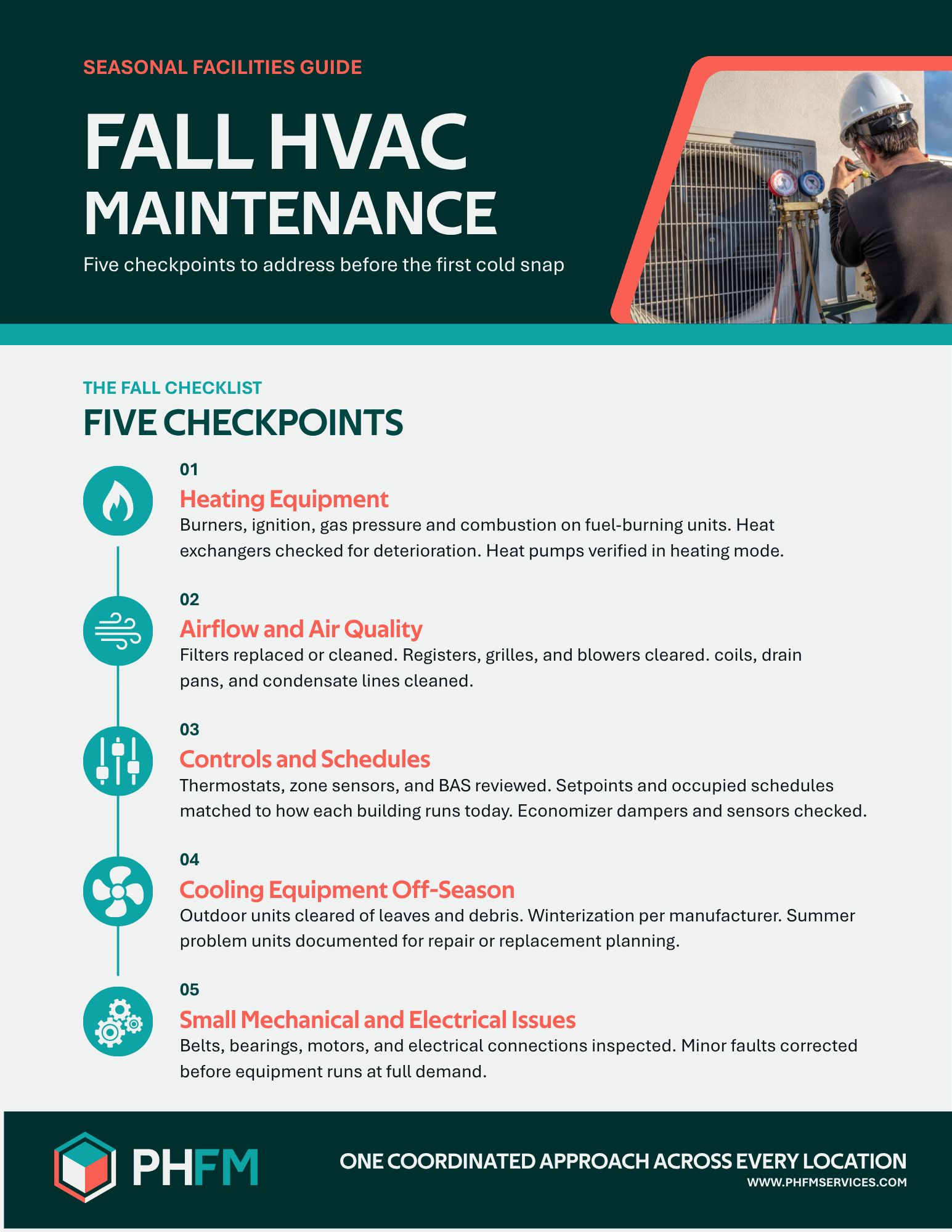
For fuel-burning equipment, technicians inspect burners, ignition components, gas or oil connections, gas pressure, and combustion. Heat exchangers get particular attention, since deterioration or damage can affect safe operation.
ANSI/ASHRAE/ACCA Standard 180, which sets minimum inspection and maintenance practices for commercial building HVAC systems, calls for checking the heat exchanger, combustion chamber, burner, and flue for deterioration, moisture, condensation, and combustion products, then cleaning, testing, and adjusting the combustion process as needed. Safety devices should be verified against manufacturer recommendations.
Heat pumps require their own seasonal attention. As systems transition from cooling to heating, technicians verify heating operation and inspect components based on manufacturer requirements. Fall is also an opportunity to catch performance issues that developed during a demanding summer.
Check Airflow, Filters, and Indoor Air Quality
Heating equipment is only one part of the system. Conditioned air still has to move efficiently through the building.
Fall maintenance should include checking air filters and replacing or cleaning them when accumulation starts to affect pressure drop or pushes airflow outside established operating limits. Registers, grilles, blowers, and other air distribution components should be inspected for dirt, debris, or obstructions that could restrict airflow.
Coils, drain pans, and condensate lines should be inspected and cleaned as needed. Keeping these components clear supports proper heat transfer and drainage while reducing the potential for water-related issues.
Airflow issues often show up as inconsistent conditions across a property. Rooms that are noticeably warmer or colder than surrounding areas, weak airflow at registers, or repeat occupant complaints can all signal that part of the system needs attention. Left unaddressed, restricted airflow forces equipment to run longer to reach setpoint, which adds unnecessary energy use and accelerates wear on components.
Review Controls Before Heating Schedules Take Over
Fall is also a good time to look beyond the mechanical equipment and review how the HVAC system is being controlled.
Thermostats, zone sensors, and Building Automation System controls should accurately reflect conditions throughout the property. Teams review heating setpoints, occupied and unoccupied schedules, and other control strategies to confirm they still match how each building is being used. This matters most at properties where occupancy patterns have changed. Continuing to operate from an outdated schedule can result in unnecessary heating or spaces that are uncomfortable for occupants.
Control strategies deserve the same seasonal attention as the equipment itself. A sequence that performed well through cooling season isn’t necessarily the right one for heating season and reviewing it in fall is easier than diagnosing it in January.
For buildings with economizers, fall maintenance should include checking dampers, sensors, and controls. Mild outdoor temperatures create opportunities to use outdoor air for cooling when conditions allow, which makes proper economizer operation especially relevant this time of year.
Prepare Cooling Equipment for the Off-Season
Preparing for heating season also means giving cooling equipment attention after months of use.
Outdoor equipment should be inspected and cleared of leaves, branches, dirt, and other debris. Depending on the system and local climate, certain cooling components may also require seasonal shutdown or winterization according to manufacturer recommendations.
This is also the time to document cooling-system issues while they’re still fresh rather than rediscovering them on the first warm day of spring. If a unit struggled through the summer, required repeated service, or has aging components, the off-season is when repair or replacement planning can happen.
Look for Small Mechanical and Electrical Problems
Not every HVAC problem starts with a major failure. Worn belts, loose electrical connections, deteriorating bearings, and unusual vibrations are minor faults that become major ones when they go unaddressed.
During fall maintenance, technicians inspect electrical connections, motors, belts, bearings, and blower assemblies, and monitor equipment for unusual sounds such as banging, rattling, or screeching. Addressing these warning signs during planned maintenance helps avoid the same component failing when equipment is working hardest.
This preventive approach also supports better energy performance. The U.S. Department of Energy’s Better Buildings Solution Center reports that organizations can save 5% to 20% annually on energy bills by following operations and maintenance best practices.
Fall HVAC Checklist at a Glance
Reduce the Risk of No-Heat Emergencies
The first stretch of cold weather isn’t the ideal time to learn that a heating system has a problem. Once temperatures drop, equipment runs for longer stretches, and issues that were barely noticeable in milder weather become operational concerns quickly.
For facilities managers overseeing multiple properties, that risk compounds. A no-heat call can mean coordinating emergency service, communicating with occupants, managing potential closures or disruptions, and responding to several locations at once during widespread cold weather. Fall maintenance is what turns that scenario into a scheduled repair instead of an emergency dispatch.
Make Fall HVAC Maintenance Part of the Bigger Picture
A commercial HVAC system has a direct impact on building operations, energy consumption, indoor air quality, and occupant comfort. Standard 180 frames inspection and maintenance around exactly those priorities: thermal comfort, energy efficiency, and indoor air quality. For multi-site portfolios, the challenge is making sure they’re addressed consistently across every location.
PHFM helps facilities teams coordinate commercial HVAC maintenance and service needs across their portfolios through one point of contact. A national network of vetted providers means inspections can follow each region’s heating season rather than a single calendar date. MetryX, PHFM’s technology platform, keeps service activity across every location in a single view. From seasonal inspections and preventive maintenance to repairs and ongoing service needs, a coordinated approach provides greater visibility into property conditions and helps keep locations prepared as building demands change.
Fall is the window. Taking advantage of it means fewer surprises when colder weather arrives.
PHFM can help teams put a fall inspection schedule in place before that window closes.